
ServeLume / Proof of work app
Good work.A clearer record.
Give the office more than a completion status. Keep useful evidence alongside the work it explains.
Explore your workflow · Review live plans · Bring your team
THE DETAILS CONNECT THE WORK
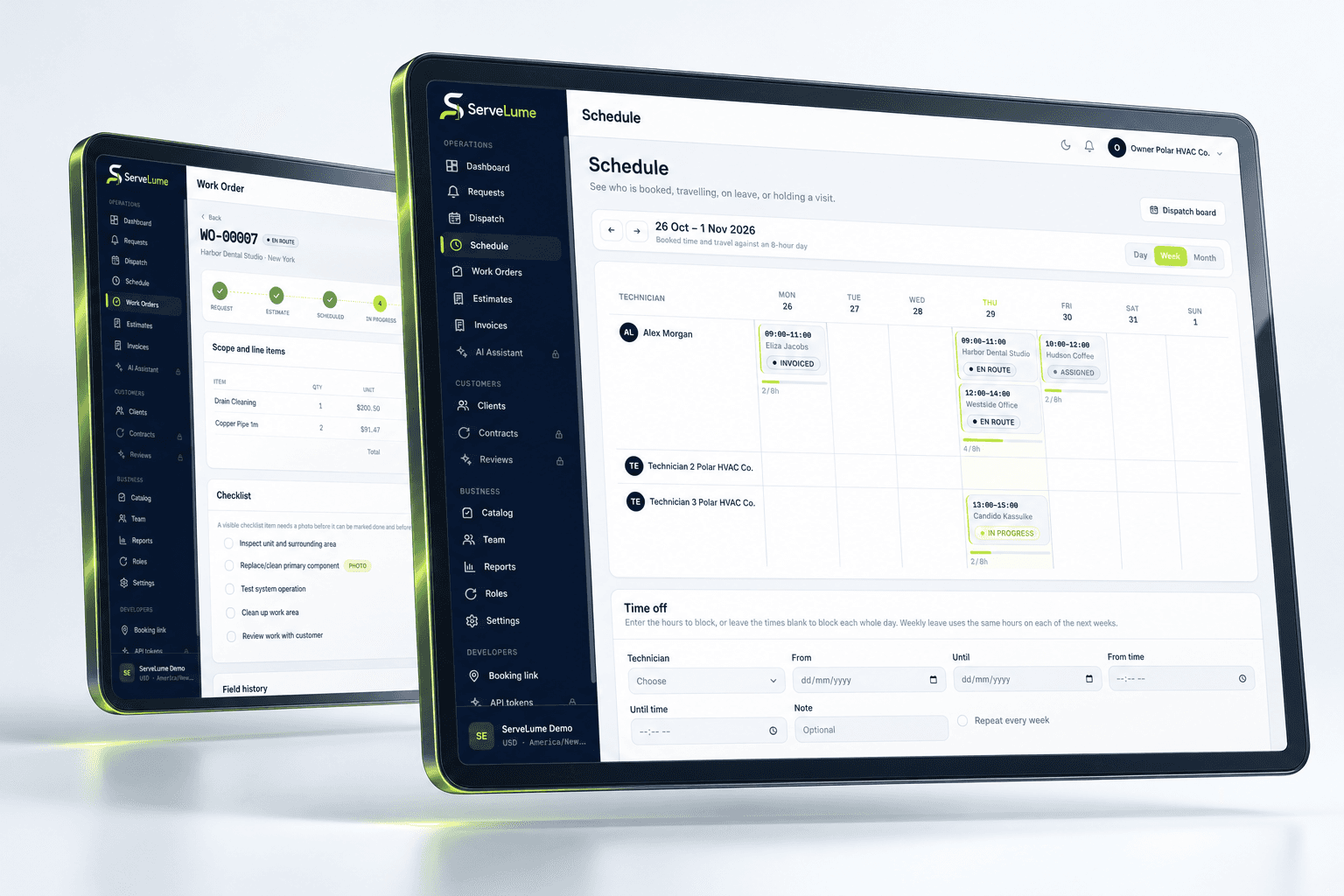
A completed job should leave a useful explanation. A proof of work app connects photographs, checklist responses and customer acknowledgement with the service visit, giving your office something more informative than a completion tick.
- Job-linked photographs
- Purposeful mobile checklists
- Customer handover records
01 / Evidence with context
Keep the photo beside the work.
Job photo documentation is useful when the image explains a relevant condition or result. Keep before-and-after photographs connected to the visit so your office can review the service context without searching personal camera rolls or asking the technician to resend files.
A photograph should show why it matters. Include a concise note when the result would otherwise be unclear, and avoid unnecessarily capturing people, private documents or unrelated possessions. Your team decides the evidence appropriate to the task and remains responsible for consent, information handling and professional judgement.
- Connect photographs to the service visit
- Explain relevant findings and results
- Reduce reliance on separate image messages
02 / A consistent service routine
Make the checklist serve the job.
A mobile job checklist app can support a consistent review, but more questions do not automatically make a better record. Use configured checklist responses to preserve the details your office needs and let notes explain exceptions or limitations at the service location.
Begin with the outcome you need to understand. A short checklist that matches the work is more useful than a long form completed without context. Review the actual configured workflow during evaluation, especially where a specialist trade requires technical measurements, statutory forms or qualified review outside the general job record.
- Use responses appropriate to the service
- Record exceptions with clear notes
- Keep checklist context with the job
03 / An understandable handover
Keep acknowledgement in context.
A customer signature can support a service handover when your business has agreed what it means. Connect the acknowledgement with the job record so the office can review the work, relevant evidence and the customer conversation together.
Do not treat a signature as proof of every claim, legal conclusion or compliance requirement. The customer should understand the acknowledgement, and your business should distinguish acceptance of a visit from approval of extra work or an additional charge. Use the record to explain the process your team actually follows.
- Connect sign-off with its service record
- Review the evidence behind the handover
- Keep additional approvals explicit
A PRACTICAL WAY TO WORK
A clear path. From one person to the next.
Make the handover deliberate, at every stage of the service.
- 01
Agree what to capture
Choose the photos, responses and acknowledgement that explain a typical job. Keep the evidence standard relevant and practical.
- 02
Record it at the visit
Preserve the findings while your technician has the context. Add notes that explain exceptions rather than relying on unexplained attachments.
- 03
Review the full story
Ask the office to understand the work from the record. Confirm the next customer action and distinguish it from technical certification.
BUILT TO BE EVALUATED BY YOUR TEAM
Would the record make sense to someone who was not there?
Choose a sample visit with a visible finding, a checklist exception and a customer handover. Ask a colleague who did not attend to explain the result using the record alone. Check that the images are relevant, the responses are understandable and the acknowledgement has a clear meaning. Evaluate privacy, access and specialist documentation requirements before making the process part of your regular service.
Discuss your workflowA FEW USEFUL ANSWERS
Clarity before you commit.
Understand the workflow, the requirements and the boundaries.
01What is proof of work in a field service workflow?
It is relevant job evidence such as photographs, notes, checklist responses and customer acknowledgement. Its purpose is to help explain the service performed and the next action, not to imply an independent legal or compliance certification.
02Can photos replace a written service note?
Sometimes an image communicates a finding clearly, but a short explanation may still be needed. Record why the photo matters, what was observed and any limitation that the office or next technician should understand.
03Does a completed checklist certify compliance?
No. A general checklist does not replace qualified judgement, licensing, safety procedures or mandatory trade documentation. Confirm the specialist requirements that apply to your business and keep those responsibilities explicit.
04What should a customer signature acknowledge?
That depends on the service and agreement your business uses. Make the acknowledgement understandable and separate completion of a visit from approval of additional scope, charges or other commitments.
YOUR NEXT CONNECTED WORKDAY
Bring the whole job
into the picture.
Start with a real workflow question. Explore the product with the people who plan the work and the people who do it.